
Views: 63 Author: Rice Lighting Publish Time: 2024-12-24 Origin: www.ricelighting.com
Lenses are made according to the law of light refraction. Lenses are optical elements made of transparent materials (such as glass, crystal, etc.). Lenses are refracting mirrors whose refractive surfaces are two spherical surfaces (part of a spherical surface), or a spherical surface (part of a spherical surface) and a flat transparent body. The images it forms are both real and virtual. Lenses can generally be divided into two categories: convex lenses and concave lenses. Convex lenses are thicker in the middle than in the edge, and there are three types: biconvex, plano-convex, and concave-convex; concave lenses are thinner in the middle than in the edge, and there are three types: biconcave, plano-concave, and convex-concave.
LED lenses are generally silicone lenses. Because silicone has high temperature resistance (it can also be reflow soldered), it is often directly packaged on LED chips. Generally, silicone lenses are small in size, with a diameter of 3-10mm. In addition, LED lenses are generally closely connected with LEDs, which helps to improve the light output efficiency of LEDs and the optical system of lenses that change the light field distribution of LEDs.
Because silicone has high temperature resistance, it is often directly packaged on LED chips. Generally, silicone lenses are small in size, with a diameter of 3-10mm.

 Optical grade PMMA (polymethyl methacrylate, commonly known as: acrylic), plastic material, advantages: high production efficiency (can be completed by injection molding, extrusion molding). High light transmittance (penetration rate is about 93% at 3mm thickness); disadvantages: temperature cannot exceed 80° (thermal deformation temperature 92 degrees).
The main material of LED lens on the market is PMMA, which has good plasticity and high light transmittance (up to 93%), but its disadvantage is low temperature resistance, only about 90 degrees. The main secondary lenses on the market are generally designed with total internal reflection (TIR for short). The design of the lens uses penetrating focusing in front, and the conical surface can collect and reflect all the side light. The overlap of these two kinds of light can obtain perfect light utilization and beautiful light spot effect. The efficiency of TIR lens can reach more than 90%, and it is mainly used in small-angle lamps (beam angle <60°), such as spotlights and ceiling lights.
(Optical grade material Polycarbonate (PC for short). Plastic material, advantages: high production efficiency (can be completed by injection molding and extrusion); slightly low light transmittance (penetration rate is about 89% when the thickness is 3mm); disadvantages: the temperature cannot exceed 110° (heat deformation temperature 135 degrees).
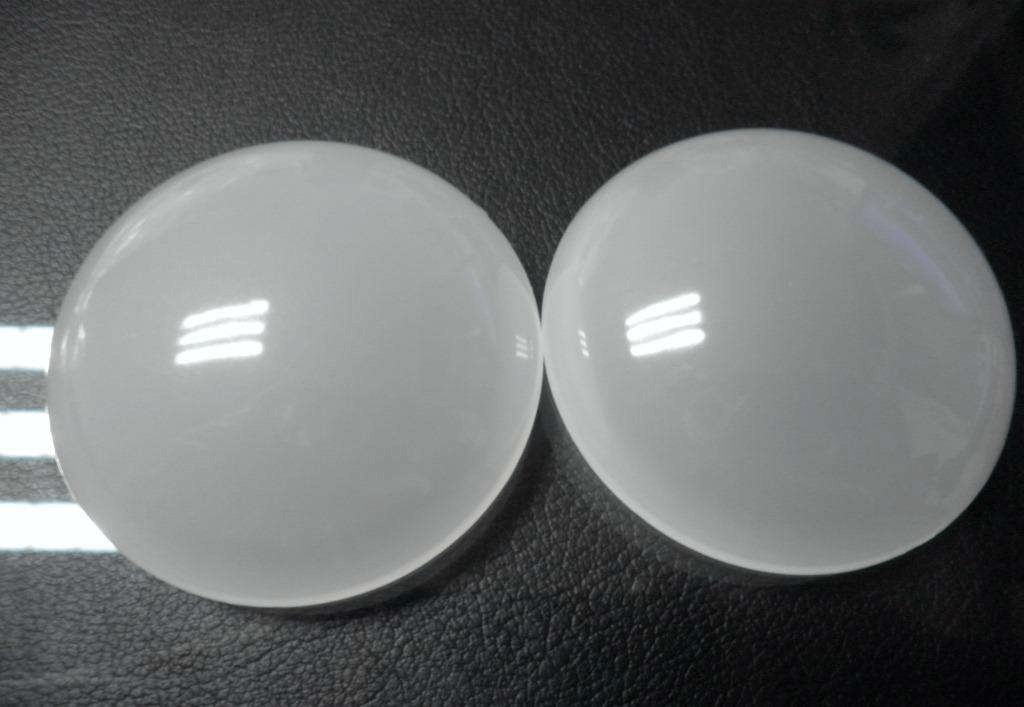
Optical glass material, advantages: high light transmittance (97% transmittance at 3mm thickness), high temperature resistance; disadvantages: large size and heavy weight, single shape, fragile, difficult to achieve mass production, low production efficiency, cost higher.
Functions of glass lenses: 1. Condensing light. One of the most significant functions of LED glass lenses is to focus light. The light emitted by the LED chip itself is relatively dispersed. Through the refraction of the glass lens, the light can be concentrated in a specific direction, improving the intensity and directionality of the light. This is very useful in situations where long-distance lighting or specific area lighting is required, such as road lighting, stage lighting, etc. The concentrated light can illuminate the target area more effectively, reduce light waste, and improve lighting efficiency.
1. Control light pattern . Different shapes of LED glass lenses can control the shape and distribution of light. For example, by designing a specific lens surface, you can achieve a circular light spot, a rectangular light spot, or other special shapes of light spots. This allows LED lamps to meet a variety of different lighting needs. For example, indoor lighting requires uniform and soft light distribution, while outdoor landscape lighting may require a specific shape of light spot to create a unique effect.
2. Improve light efficiency. Glass lenses have high light transmittance and can reduce light loss during transmission. Compared with lenses made of other materials, LED glass lenses can better transmit light and improve light utilization. At the same time, the surface of glass lenses can be specially treated, such as anti-reflective coating, to further reduce light reflection loss and improve light efficiency.
3. Protect LED chips. LED glass lenses can protect LED chips. They can prevent dust, moisture and other external factors from corroding the chips, extending the service life of LED lamps. In addition, glass lenses can also withstand certain external impacts, providing additional protection for fragile LED chips.
The primary lens is directly packaged (or bonded) on the LED chip bracket, generally made of PMMA, PC, optical glass, silicone and other materials. It becomes a whole with the LED. Theoretically, the LED chip emits 360 degrees, but in fact, the chip is fixed and packaged on the LED bracket, so the maximum luminous angle of the chip is 180 degrees (there is also a small amount of residual light in the range greater than 180 degrees). In addition, the chip will have some stray light. In this way, the primary lens can effectively gather all the light of the chip and obtain different light output angles such as 180°, 160°, 140°, 120°, 90°, 60°, etc. However, the light output efficiency of LEDs with different light output angles is somewhat different (the general rule is: the larger the angle, the higher the efficiency).
The secondary lens and LED are two independent objects, but they are inseparable in application. The function of the secondary lens is to converge the light angle of the LED light source into any desired angle between 5° and 160°. The distribution of the light field can be mainly divided into: circular, elliptical, and rectangular. The secondary lens material is generally optical grade PMMA or PC; glass can be selected in special cases.
When the LED light passes through a curved surface of the lens (double convex has a curved surface), the light will be refracted and focused, and when the distance between the lens and the LED is adjusted, the angle will also change (the angle is inversely proportional to the distance). The optically designed lens spot will be very uniform, but due to the limitations of the lens diameter and lens mode, the LED light utilization rate is not high and the edge of the spot has a relatively obvious yellow edge; it is generally used for focusing at a large angle (more than 50°), such as table lamps, bar lamps and other indoor lighting fixtures;
The lens is designed to focus light in the front with penetration, while the conical surface can collect and reflect all the side light. The overlap of these two kinds of light (same angle) can obtain the most perfect light utilization and beautiful light spot effect. The surface of the conical lens can also be changed to obtain different light spot effects by designing it into mirror surface, frosted surface, bead surface, striped surface, threaded surface, convex or concave surface, etc.
It is to make a whole multi-lens by injection molding multiple single lenses. According to different needs, it can be designed into a 3-in-1, 5-in-1 or even dozens of lenses in one lens module; it can also combine two separate lenses through a bracket. This design effectively saves production costs, achieves consistency in product quality, saves space for lamp mechanisms, and makes it easier to achieve "high power" and other characteristics.
1. LED Lens Material Requirements: LED lenses require high-quality materials with strict standards for light transmittance, thermal stability, and uniformity. Generally, optical-grade PMMA is preferred, with optical-grade PC used for special needs. Mitsubishi's PMMA (VH001) is considered the best, while Nantong Liyang, a Mitsubishi branch in China, is slightly lower in quality.
2. Cleanroom Standards: A Class 10,000 dust-free workshop or higher is needed for production. Operators must wear anti-static clothing, gloves, and masks, and the room must be regularly cleaned and inspected.
3. Injection Molding Machines: Specialized machines from brands like Toshiba, Demag, Haitian, and Chen Hsong are required to ensure proper injection molding and produce high-quality lenses.
4. Product Inspection: Lenses must be free of defects like bubbles, dents, or shrinkage marks. Shape accuracy should be Rt<0.005, and surface roughness should be Ra<0.0002.
5. Packaging and Storage: Products must be packaged in anti-static, dust-proof PVC bags and sealed. Temperature and humidity should be controlled during storage, and lenses should not be kept for more than one year.
LED lenses, although seemingly simple, have high standards in both design and production, which explains the price differences in the market. As LED lighting continues to grow, the demand for quality lenses will increase, making them a key component with a strong market outlook.
1. First of all, it depends on the light source (high-power LED). Different brands of high-power LEDs (such as CREE, Lumileds, Seoul, Osram, Edison, Changsenyuan, etc.) have different chip structures, packaging methods, and light characteristics, which will cause the same lens to be different when paired with different specifications and brands of LEDs; therefore, targeted development (oriented to mainstream brands) is required to meet actual needs;
2. Use optical design software (such as Tracepro, CodeV, Zemax, etc.) to design and simulate optical light dispersion, and obtain the corresponding optical aspheric surface;
3. LED lens itself is a precision optical component, so it has extremely high requirements for mold precision, especially the processing precision of the lens optical surface must reach 0.1μm, and the lens eccentricity must be within 3μm. Generally, the processing of such high-precision molds must have the following equipment: ultra-precision processing machine (for example: PRECITECHNANOFORM350), CNC comprehensive processing machine, surface grinder, milling machine, CNC EDM machine, surface profiler, etc.
4. The most precise part of the mold is the optical mold core. First, we select special mold core steel to complete the initial blank. After nickel plating, we use ultra-precision processing machine to process the curved surface with aspheric technology.
1. Regardless of the distance, there is not much difference between the lampshade (reflector cup) and the lens. In terms of uniformity, the lens is better than the reflector cup.
2. Use a small-angle LED lens, which is better than a lampshade because it can emit light farther! The light from the lampshade has already been concentrated by the lens (because the LED itself must have a lens) and then by the light cover, which will waste a lot of light. It is better to concentrate the light at the lens, and the light-emitting angle of the lens is easy to handle.
In addition: If space permits, using three 1W units will produce much better results than using one 3W unit.
3. In comparison, the lampshade has a large uniform light distribution range, but the light projection is not good, while the lens is the opposite.
4. LED transparency looks more upscale.
If you are looking for a lighting solution that can make your business more effective and attract more customers' attention, then please give priority to the Rice Lighting company. These led lightings will be a great way to grab attention and create an interactive experience for customers.
Thanks for your time for reading :)
----END----


